

Blog
Manufacturer vs Trader: What’s the Difference?


Whether you’re sourcing fabric for a clothing brand, retail store, export business, or wholesale market, one question always comes up:
Should you buy directly from a manufacturer or from a trader?
Understanding the difference can save you money, improve product quality, reduce delivery delays, and help build a stronger supply chain.
In this guide, we’ll explain everything you need to know about manufacturers and traders, their advantages and disadvantages, and which option is best for your business.
What Is a Manufacturer?
A manufacturer is a company that produces products using raw materials, machinery, skilled labor, and quality control systems.
In the textile industry, manufacturers purchase yarn, weave or knit fabric, process it through dyeing and finishing, inspect quality, and supply the finished fabric to wholesalers, retailers, exporters, or brands.
Manufacturers typically offer:
- In-house production
- Better quality control
- Product customization
- Large production capacity
- Consistent supply
- Competitive factory pricing
What Is a Trader?
A trader (or distributor) purchases products from different manufacturers and sells them to customers.
They usually don’t own manufacturing facilities. Instead, they act as intermediaries between factories and buyers.
Traders often maintain inventories from multiple manufacturers and offer a wider selection under one roof.
Traders typically provide:
- Ready stock
- Multiple product options
- Lower minimum order quantities
- Faster purchasing process
- Easy sourcing from different brands
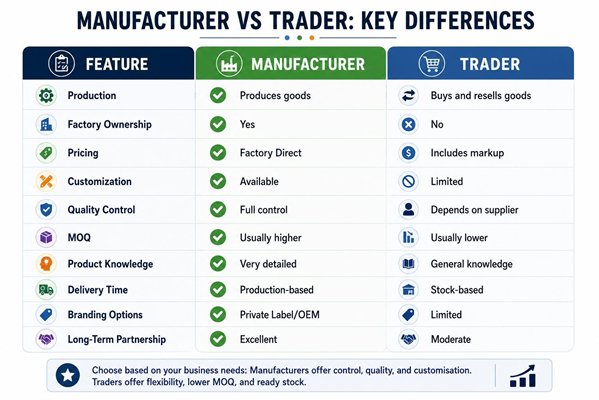
Manufacturer vs Trader: Key Differences
Price Comparison
One of the biggest reasons buyers choose manufacturers is cost savings. Buying directly from a factory removes the middleman’s commission.
Manufacturer
- Lower cost per meter
- Better pricing on bulk orders
- Volume discounts
- Stable pricing
Trader
- Higher prices
- Additional handling costs
- Multiple markups
- Better for small purchases
Winner: Manufacturer
Quality Control
Manufacturers monitor quality throughout production.
Every stage—from yarn selection to weaving, dyeing, finishing, and final inspection—is carefully managed. Traders rely on the quality standards of the factories they source from.
Manufacturer Advantages
- Fabric inspection
- Shade consistency
- Shrinkage testing
- Strength testing
- Final quality assurance
Winner: Manufacturer
Product Customisation
If you’re launching your own textile brand, customisation is essential. Manufacturers can offer:
- Custom colours
- Exclusive fabric designs
- Special finishes
- Customised GSM
- Private labelling
- Custom packing
- Brand tags
- Exclusive collections
Most traders can only supply existing products.
Winner: Manufacturer
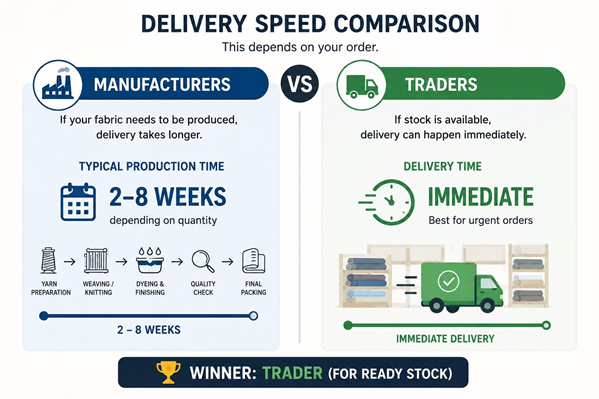
Delivery Speed
Minimum Order Quantity (MOQ)
Manufacturers usually require higher MOQs because production becomes economical at larger volumes. Example:
Manufacturer:
- 500–2,000 meters Trader:
- 20–200 meters
If you’re a startup, traders may be more suitable initially.
Product Variety
Traders usually source products from multiple factories. That means you can compare:
- Cotton
- Wash & Wear
- Linen
- Blended Fabrics
- Premium Suiting
- Printed Fabrics
- Seasonal Collections
Manufacturers usually specialise in their own production range.
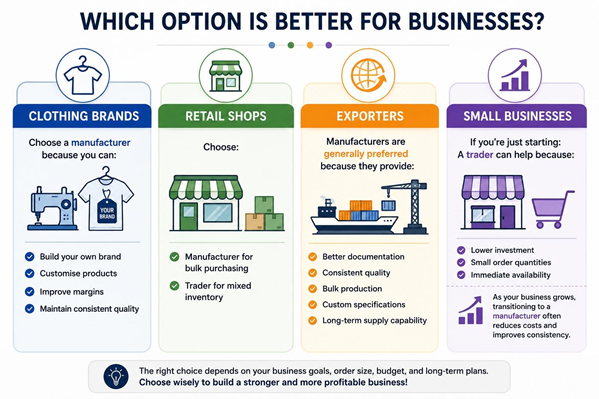
Advantages of Buying Directly from a Manufacturer
✔ Factory-direct pricing
✔ Better profit margins
✔ Consistent quality
✔ Product customisation
✔ Reliable production schedules
✔ Long-term business relationships
✔ Technical support
✔ Better communication
✔ Brand development opportunities
When Should You Buy from a Trader?
Buying from a trader makes sense when you need:
- Small quantities
- Fast delivery
- Multiple product categories
- Market testing
- Immediate stock availability
Common Misconceptions “Manufacturers are always expensive.”
Not necessarily.
Although minimum order quantities may be higher, the cost per unit is usually lower than buying through a trader.
“Traders have better quality.”
Quality depends on the original manufacturer.
A trader does not produce the product—they only source and resell it.
“Manufacturers only sell to large companies.”
Many modern manufacturers now work with startups, fashion brands, online businesses, and small wholesalers by offering flexible production options.
How to Choose the Right Supplier
Before placing an order, ask these questions:
- Do they own a manufacturing facility?
- Can they provide product specifications?
- Do they offer customisation?
- What quality control processes do they follow?
- What is their minimum order quantity?
- Can they supply consistently throughout the year?
- Do they provide after-sales support?
- Can they share samples before bulk production?
Choosing the right partner involves balancing price, quality, lead time, and service—not just finding the lowest quote.
Why Buying Directly from a Manufacturer Creates Long-Term Value
Working directly with a manufacturer gives businesses greater control over product quality, branding, and production planning. Over time, direct relationships can lead to better pricing, improved communication, and the flexibility to develop exclusive products that help your business stand out in a competitive market.
For growing apparel brands, wholesalers, and exporters, partnering with a reliable manufacturer often becomes a strategic investment rather than simply a purchasing decision.
Conclusion
Both manufacturers and traders play important roles in the textile supply chain.
If you need small quantities and immediate availability, a trader can be the right choice.
However, if your priority is better pricing, consistent quality, customisation, and long-term business growth, buying directly from a manufacturer is generally the better option.
Understanding these differences allows you to make smarter sourcing decisions, strengthen your supply chain, and build a more profitable business.